

A radio station log is the official, FCC-mandated record that documents the operation of a licensed broadcasting station, governed by 47 CFR §73.1800 and §73.1820. Every commercial, noncommercial, and educational broadcast station in the United States must maintain one. The log captures what aired, when it aired, who was responsible, and whether the station operated within its licensed parameters. If you run a radio station or work in broadcast operations, understanding this record is not optional. It is the foundation of your regulatory accountability.
What is a radio station log and why does it matter?
A radio station log, formally called a broadcast station log, is a legal evidentiary record used by the FCC and station staff to verify that a station operated as authorized. The distinction matters: this is not a simple program schedule or playlist export. Each entry is an attested legal statement, meaning the person who signs it confirms they have actual knowledge of the facts recorded.
The FCC uses these records during license renewals, complaint investigations, and field inspections. A station that cannot produce its log on demand faces serious regulatory exposure. The log also serves internal purposes, giving station managers a reliable record of what content aired and when, which is critical for resolving advertiser disputes or confirming public affairs programming.

Many operators confuse a broadcast station log with an amateur radio logbook. These are fundamentally different records with different purposes, different fields, and different regulatory frameworks. That distinction is covered in detail later in this article.
What are the FCC requirements for a radio station log?
The FCC’s rules under 47 CFR §73.1800 establish the baseline: every broadcast station must maintain a station log, and entries must be made by a competent employee with actual knowledge of the facts being recorded. “Competent” here has a specific meaning. The person signing the log must be able to attest to the accuracy of each entry, not simply copy data from another source.
Here is what a compliant broadcast station log must include:
-
Station identification: Call letters, location, and licensed frequency or channel
-
Operating power and hours: Actual transmitter power levels and on/off times
-
Equipment malfunctions: Any technical issues affecting authorized operation, including when they were discovered and resolved
-
Program content records: Required public file entries, Emergency Alert System tests, and political programming disclosures
-
Signature attestation: The name and signature of the responsible employee for each entry period
Paper logs require numbered pages and entries recorded in local time with daylight saving time indicated. Electronic logs are permitted provided they can be readily accessed and produced as full-sized copies during an FCC inspection. Archive format, retrieval speed, and the authenticity of electronic signatures are all compliance factors the FCC evaluates.
Retention is a firm requirement. Station logs must be kept for two years under normal circumstances. If a log is tied to an active FCC investigation, a complaint, or a declared disaster, it must be retained until the FCC explicitly authorizes its destruction. Discarding a log prematurely during an open investigation is a separate compliance violation.
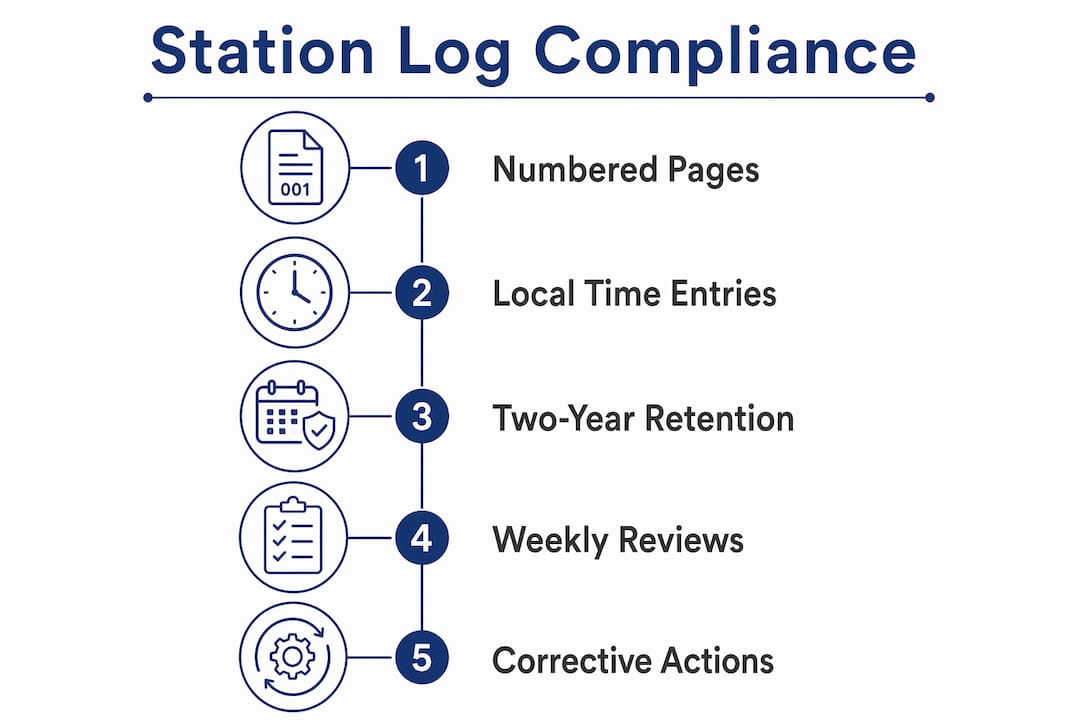
Chief Operators must review station logs weekly, sign to attest that review, and take corrective action on any discrepancies. Electronic signatures are acceptable when the station can verify the signer’s identity and the integrity of the log entry. This weekly review cycle is one of the most commonly overlooked obligations at smaller stations.
Pro Tip: Set a recurring calendar reminder for your Chief Operator’s weekly log review. Missed review signatures are one of the most common findings during FCC inspections, and they are entirely preventable.
How does broadcast automation interact with station logging?
Modern broadcast automation systems have changed how station logs are generated, but they have not changed who is legally responsible for them. Automation software integrates scheduling, music rotation, and traffic logs into a unified playout queue that produces compliance logs automatically. This reduces the manual data entry burden significantly and cuts the risk of transcription errors.
Here is how automation typically interacts with the logging workflow:
-
Schedule generation: The automation system builds a daily program clock from music libraries, traffic spots, and syndicated content blocks.
-
Real-time playout logging: As each item plays, the system timestamps it and records the actual air time, duration, and content identifier.
-
Reconciliation: The system compares the scheduled log against the as-aired log, flagging any discrepancies for staff review.
-
Compliance export: The final log is exported in a format suitable for FCC record-keeping, including all required fields.
-
Archiving: Logs are stored in a searchable archive, making retrieval fast during inspections or internal audits.
Automation-driven logs provide a single source of truth for what actually aired, which is critical when reconciling scheduled versus broadcast content. Advertisers, rights organizations, and regulators all rely on this record. A manual log that does not match the actual playout is a liability. An automated log that captures real-time playout data is far more defensible.
The key caveat is that automation does not sign the log for you. Integrating scheduling, traffic, and music logs into a single compliance record reduces human error, but a qualified staff member must still review and attest to the accuracy of the final record. The legal responsibility stays with the station.
Pro Tip: When evaluating automation platforms, confirm that the system produces an as-aired log with timestamps, not just a schedule export. These are different records, and only the as-aired log satisfies FCC documentation requirements.
How to properly use and maintain a radio station log
Maintaining a compliant station log comes down to consistency, accuracy, and clear accountability. These practices keep you audit-ready at all times:
-
Log in real time. Entries made after the fact are harder to defend and easier to challenge. Record equipment readings, on/off times, and incidents as they happen.
-
Use the correct time format. Paper logs require local time with a daylight saving time notation. Electronic systems should be configured to record both local and UTC time where relevant.
-
Never leave entries unsigned. An unsigned log entry has no legal standing. Every entry period must have the signature of a competent employee with actual knowledge of the facts.
-
Document malfunctions immediately. If a transmitter drops power or an EAS test fails to run, log it at the time of discovery. Include what happened, when it was noticed, and what corrective action was taken.
-
Conduct the weekly Chief Operator review without exception. Electronic signatures are accepted when the station can verify identity and log integrity, so remote review is feasible for multi-site operations.
-
Archive with retrieval speed in mind. The FCC expects you to produce records quickly during an inspection. An archive that takes hours to search is a practical compliance risk even if the records exist.
For stations choosing between paper and electronic logs, electronic systems win on every operational metric. They are searchable, harder to alter without detection, and easier to produce in full-sized copies on demand. The transition from paper to electronic logs requires confirming that your system meets FCC accessibility and authenticity standards before you retire the paper process entirely.
Pro Tip: Run a mock inspection once a year. Ask a staff member to pull the station log for a specific date from two years ago and produce a full-sized copy within 30 minutes. If they cannot do it, your archive process needs work before the FCC asks.
Key takeaways
A radio station log is a legally binding operational record, and treating it as anything less creates compliance risk that no broadcaster can afford.
| Point | Details |
|---|---|
| Legal definition | A broadcast station log is an FCC-required record under 47 CFR §73.1800, not a simple program schedule. |
| Retention rule | Logs must be kept for a minimum of two years, and longer if tied to an active FCC investigation. |
| Automation advantage | Broadcast automation systems generate as-aired logs automatically, reducing errors and providing a defensible compliance record. |
| Broadcast vs. ham logs | Ham radio logs are voluntary personal records; broadcast station logs are mandatory legal instruments with inspection risk. |
| Weekly review obligation | Chief Operators must review and sign station logs weekly, with electronic signatures accepted when identity and integrity can be verified. |
Why station logs deserve more attention than most operators give them
I have worked with broadcasters across commercial groups, community stations, and educational outlets, and the pattern is consistent. Station logs get treated as administrative overhead until something goes wrong. An FCC complaint lands, a license renewal triggers a records request, or an advertiser disputes a spot run. At that point, the quality of your log is the difference between a clean resolution and a protracted regulatory headache.
The shift to automation has genuinely improved log accuracy at most stations. When a system timestamps every item at playout and reconciles it against the schedule, you eliminate the transcription errors that plagued manual logs. But I have seen stations assume that because automation generates the log, the compliance obligation is handled. It is not. The log as a legal record still requires human attestation. The system captures the data; a qualified person confirms it.
The other thing operators consistently underestimate is the retention requirement during investigations. Two years sounds like a long time until you realize an FCC complaint can arrive 18 months after the incident in question. Stations that purge logs on a rolling two-year schedule without checking for open matters create a problem that no amount of goodwill can fix.
My honest recommendation: treat your station log the way a law firm treats client files. Accurate, signed, retained, and retrievable on demand. That posture costs very little in operational terms and protects you completely when it matters.
— Liam
How Broadcast Radio helps you stay log-compliant
Broadcastradio builds professional radio automation and cloud broadcasting tools designed for the full broadcast workflow, including compliance logging. The platform generates as-aired logs automatically from the playout system, reconciles them against your schedule, and archives them in a format that meets FCC accessibility and inspection requirements. You get audit-ready records without the manual overhead.
Whether you run a single community station or manage a multi-site commercial group, Broadcastradio gives your Chief Operator a clean, searchable log record and your engineering team the tools to produce full documentation on demand. Explore how Broadcastradio’s broadcast software solutions can simplify your compliance process and reduce operational risk across your entire station operation.
FAQ
What is a radio station log used for?
A radio station log documents station operations for FCC compliance, providing a legal record of what aired, when, and under what technical conditions. It is used during license renewals, FCC inspections, and complaint investigations.
How long must a radio station keep its log?
Station logs must be retained for a minimum of two years under normal circumstances. If a log is connected to an FCC investigation or a declared disaster, it must be kept until the FCC authorizes its destruction.
Can a radio station use electronic logs instead of paper?
Yes. The FCC permits electronic logs provided the station can readily access them and produce full-sized copies during an inspection. Electronic signatures are accepted when the station can verify the signer’s identity and the integrity of the record.
Who is responsible for reviewing the station log each week?
The Chief Operator is required to review the station log weekly, sign to attest that review, and take corrective action on any discrepancies found. This obligation applies regardless of whether the station uses paper or electronic logging.